
About Me
My name is not important. What matters is that I am a normal person — a guy who spent decades building businesses, raising a family, and doing what most people do: moving fast, working hard, and mostly ignoring the signals my body and mind were sending me. I am 59 years old. And I am here to tell you that the second half of life does not have to look the way our culture says it does.
Where This All Began
I grew up thin and active. There was not much processed food in our house, and I was always outside running around. In the sixth grade I got a paper route that had me riding my bike two miles, six days a week. I played sports constantly. I was moving — always moving.
That changed a little as I got older and life got busier. I did not start lifting weights until my mid-thirties, and honestly, it took my wife calling me a pencil-neck nerd to get me into the gym. I have not stopped since. That is just how I am wired — once I commit to something, I see it through.
But the real turning point did not come from a gym. It came from watching the people I love suffer.
The Moment That Changed Everything
When my wife was diagnosed with breast cancer at 52, our world turned upside down. She fought it with everything she had — going through a double mastectomy and multiple additional surgeries that ultimately saved her life. She is still here, and I am grateful for that every single day. But she continues to struggle with the long-term effects of those treatments, and that reality never leaves me.
Around the same time, a close friend’s wife was diagnosed with the same type of breast cancer. She chose a different path and decided against the mastectomy. The cancer eventually spread to her lungs. She passed away a few years later.
I watched both of these women go through hell. And what I saw in the medical system troubled me deeply. The approach felt one-size-fits-all. There was a confident, almost scripted plan — eight rounds of chemotherapy, the tumor would shrink, surgery would follow, and everything would be fine. Except the tumor did not shrink. It changed in texture and shape, but it did not shrink. The plan had to change. The confidence had not accounted for that possibility.
I am not here to criticize doctors or medicine. We need them. But I do believe that the system too often treats the disease without fully accounting for the person — their background, their lifestyle, their choices, and their power to change outcomes through how they live.
Then Came My Parents
Less than three years after my wife’s diagnosis, both of my parents began showing signs of dementia. They had lived in the same house for over fifty years. That house became something they could no longer manage, and I had to move them — two people who had not prepared for this, who no longer fully understood what was happening — into an assisted living facility.
I filled three dumpsters with their belongings. If you have ever done something like that, you know it is not just a physical task. It is a grief that is hard to put into words.
They both passed away in 2025, in separate memory care facilities. By the end, neither of them knew who I was. Both had full dementia.
During those same years, I watched several friends, family members, and colleagues face cancer in their fifties and sixties. Some survived. Some did not. All of them were, in my opinion, far too young to be facing such devastating challenges.
The Question That Led Me Here
All of this affected me deeply. And it led me down a rabbit hole of research that I have not climbed out of — and honestly, have no intention of climbing out of.
I have a Bachelor of Science in Engineering and a Master’s in Business. I am not a doctor and I do not pretend to be one. But I approach everything with the same question: What is wrong here? That mindset has made me a healthy skeptic of both the healthcare industry and the food industry. Not a conspiracy theorist — a skeptic. There is a difference.
The more I researched, the more I kept arriving at the same conclusion: so many people blame their health on their genes. And while genes matter, studies are increasingly showing that genetics are responsible for only about five percent of chronic disease. The other ninety-five percent is lifestyle.
The more I looked into it, the more I became convinced: what you eat, how you move, what you believe in, and how you feel about yourself are the critical ingredients to a healthy, meaningful life. A life that does not end in a nursing home. A life that ends with dignity, surrounded by people who love you.
The Three-Legged Stool
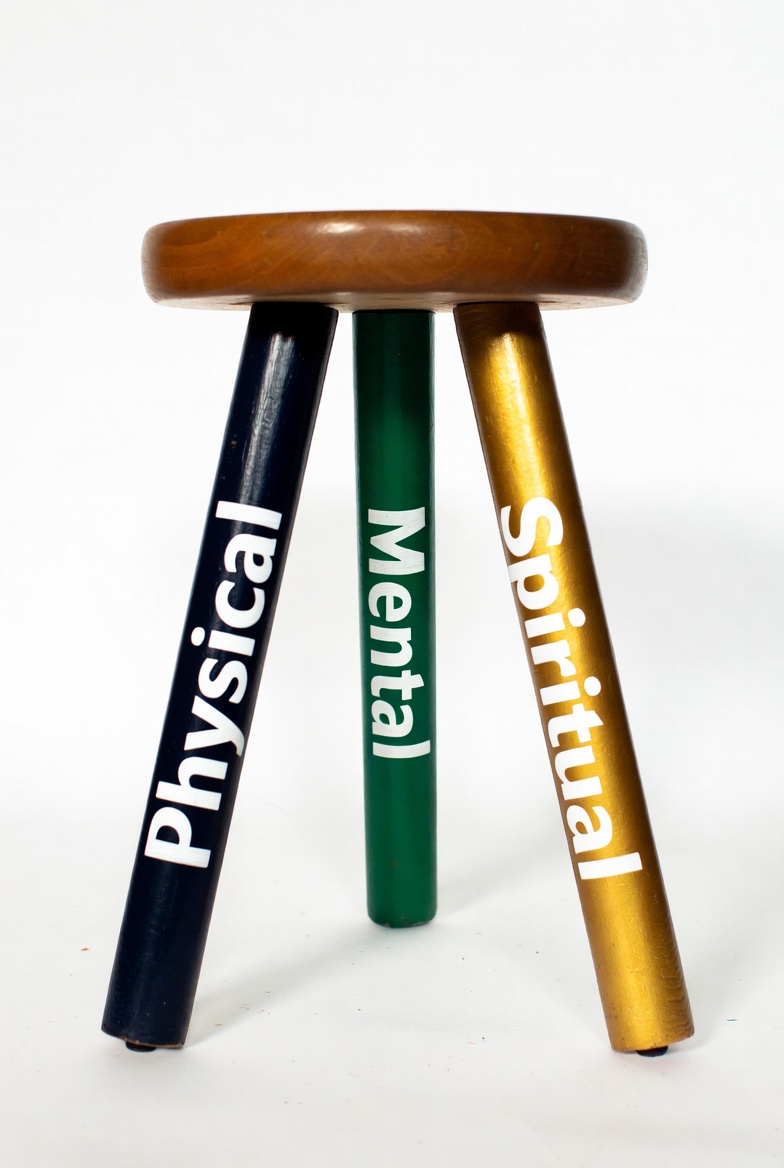
My theory is simple. A healthy, satisfying life is like a three-legged stool. The three legs are Physical Health, Mental Health, and Spiritual Health. You need all three — equally strong — or the stool tips over. Remove any one leg and the whole thing collapses. That is not a metaphor. That is biology, psychology, and thousands of years of human wisdom all pointing in the same direction.
I will be honest with you — and I believe honesty is the only thing worth offering on a site like this. The physical leg is where I am strongest. An early morning workout, a walk after lunch, minimal carbs and sugar, a walk after dinner. That is my daily foundation and it has served me well.
The spiritual leg is where I am learning to live more intentionally. I am working on gratitude — real gratitude, not the bumper sticker kind. I am trying to stay present rather than letting past failures or future worries pull me off course.
And the mental leg? That is my honest struggle. Despite what looks like a successful life from the outside — a good family, children I am proud of, financial stability, a place in my community — I have carried self-worth and confidence issues for a long time. I often feel that I have not led the kind of satisfying, meaningful life I would be proud of when I reach the end of the road.
That feeling, as uncomfortable as it is, is part of why I built this. I came across David Brooks’ book The Second Mountain, and something in it clicked for me. I feel I have reached a solid peak on my first mountain — the mountain of career, achievement, and acquisition. But I am now looking for my second mountain. One that is less about accumulating and more about giving back. One that leaves something behind that is more meaningful than a large estate.
Live Prescription Free is my second mountain.
The 7% — And Why It Matters
The best measuring stick I have found for whether you are truly on the right track is a concept I first encountered in Dr. Casey Means’ book Good Energy — which, in my opinion, is the single most important book on metabolic health written in the last decade.
Only about seven percent of the entire United States population is metabolically healthy. Seven percent. That means ninety-three out of every hundred Americans are quietly moving toward chronic disease — often without knowing it, and often being told by their doctors that their numbers are “normal.” Normal is not the same as optimal.
To be a 7 Percenter, you must meet all of the following markers — without medication:
| Marker | Optimal Range (No Medication) |
|---|---|
| Triglycerides | < 150 mg/dL |
| HDL Cholesterol | > 40 mg/dL (men) / > 50 mg/dL (women) |
| Fasting Glucose | 70–85 mg/dL |
| Blood Pressure | < 120/80 mmHg |
| Waist Circumference | < 40″ (men) / < 35″ (women) |
| Triglyceride to HDL Ratio | < 1.5 |
I became a 7 Percenter in 2024, when my annual bloodwork came back meeting all of these markers. I checked my 2026 numbers recently — they are slightly better. At 59 years old, I am in the healthiest metabolic state of my life. Not because of genetics. Because of choices made consistently, over time, across all three legs.
I am not telling you this to impress you. I am telling you this because I am proof that it is possible — and because I believe you can do it too.
The Movement — Joining the 7%
This site is not a blog. It is not a place where I dispense wisdom from on high and you passively consume it. This is a movement, and movements require community.
My goal is to find the other 7 Percenters — the people who are already living this way — and bring them together. To create a space where we can share what is working, teach each other, and collectively pull more people into this way of living. From 7% to 8%. From 8% to 9%. And beyond.
I also believe that a verified community of metabolically healthy people has real economic power. Healthy people cost the healthcare system a fraction of what the rest of the population costs. There is no reason we should be subsidizing the insurance premiums of a lifestyle we have deliberately chosen not to live. That is a conversation I intend to have — loudly, and with data.
This is my second mountain. I hope you will climb it with me.
If any part of this story sounds familiar — if you have watched someone you love struggle, if you have started asking the same questions I started asking, if you feel like there has to be a better way — then you are in the right place.
Welcome to Live Prescription Free.